

Demand for Acidity Regulator in South Korea Market Valuation, ROI Potential & Long-Term Growth Prospects 2026–2036
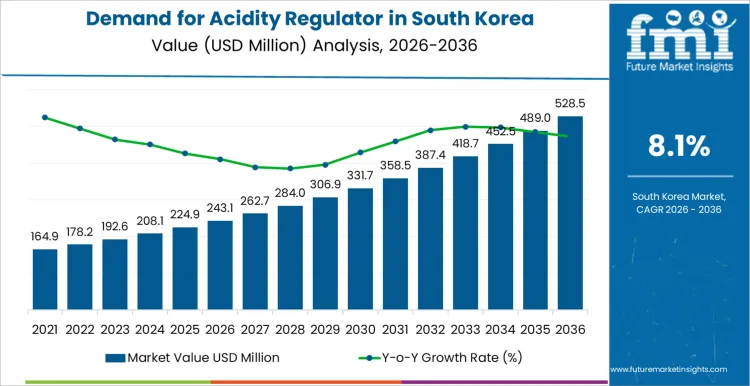
Demand for Acidity Regulator in South Korea
MD, UNITED STATES, January 21, 2026 /EINPresswire.com/ -- The demand for acidity regulators in South Korea is projected to expand significantly over the next decade, rising from USD 243.1 million in 2026 to USD 528.5 million by 2036, reflecting a compound annual growth rate (CAGR) of 8.1%. This growth is detailed in a new market analysis report published by Future Market Insights, titled "Demand for Acidity Regulator in South Korea | South Korea Market Analysis Report - 2036."
Acidity regulators, essential food additives used to control pH levels, preserve products, enhance flavors, and maintain microbial stability, play a critical role in South Korea's evolving food processing industry. The surge is primarily fueled by the global rise in popularity of K-Food—traditional and processed Korean products such as kimchi, gochujang, ready-to-eat meals, and fermented specialties—which require reliable pH control during production, storage, and international shipping to prevent spoilage and preserve characteristic taste profiles.
Domestic factors further accelerate this trajectory. South Korea's shift toward convenience foods, driven by urbanization and busy lifestyles, has increased reliance on processed items like instant noodles, lunchbox meals, and shelf-stable products available in the country's extensive convenience store network. These products depend on acidity regulators to extend shelf life while retaining sensory qualities. Additionally, the Ministry of Food and Drug Safety (MFDS) continues to enforce stringent hygiene, safety, and sodium reduction standards, prompting food manufacturers to adopt acidity regulators as effective alternatives for flavor enhancement and preservation without excessive salt use.
Market Segmentation Highlights Key Application and Product Trends
According to the report, the beverages segment leads applications with a 36.3% share in 2026. South Korean consumers' strong preference for functional drinks, ready-to-drink coffees, flavored waters, vitamin-enriched beverages, and sparkling options necessitates precise pH management to stabilize colors, flavors, and preservative efficacy. Citric and malic acids are particularly prominent in providing tartness and supporting innovations in zero-calorie and health-oriented drinks.
Among product types, acetic acid holds the largest share at 27.0%. Its dominance stems from its indispensable role in Korean cuisine's fermented staples, including kimchi, pickles, and side dishes (banchan), where it delivers the signature tang and ensures microbial safety. Acetic acid also supports large-scale production of sauces, condiments, and condiments. Other notable types include lactic acid, citric acid, maleic acid, and phosphoric acid, with organic acids gaining traction amid clean-label preferences favoring naturally derived or fermentation-based options.
Regional Dynamics Reflect Food Production Clusters
Growth varies across South Korea's regions, aligned with local food manufacturing strengths:
Jeju Island is expected to see the fastest expansion at a CAGR of 9.7%, driven by its citrus fruit production (such as hallabong and tangerines) and booming premium beverage sector featuring juices, teas, and functional drinks marketed under the "Jeju" origin brand.
South Gyeongsang Province projects a CAGR of 8.5%, supported by industrial complexes, ports, and major seafood processing and canning operations that utilize regulators for preservation.
South Jeolla, often called the "kitchen of Korea," anticipates a 7.7% CAGR, fueled by traditional fermented goods like kimchi and jeotgal (salted seafood), alongside government efforts to standardize and export regional specialties.
North Jeolla shows steady growth at 6.5% CAGR, bolstered by the National Food Cluster in Iksan, which fosters innovation in functional foods and sauces.
Competitive Landscape Features Global Leaders and Specialized Suppliers
The market features a mix of multinational corporations and specialized providers. Archer Daniels Midland Company (ADM) holds a leading 21.0% share, leveraging its global supply chain, broad acidulant portfolio, and technical support to assist Korean clients with formulation challenges. Other key players include Cargill, Incorporated and Tate & Lyle PLC, which emphasize sustainability and clean-label solutions to target premium segments. Jungbunzlauer Suisse AG and Corbion N.V. differentiate through high-purity, fermentation-derived products, appealing to export-focused manufacturers requiring certifications such as Halal, Kosher, and Non-GMO.
Request for Sample Report | Customize Report |purchase Full Report -https://www.futuremarketinsights.com/reports/sample/rep-gb-31605
Broader Industry Context and Challenges
The report underscores how acidity regulators have evolved from basic pH controllers to multifunctional ingredients supporting trends in functional nutrition, probiotic stability, and nutrient absorption. Innovations like encapsulation technologies enable controlled release in complex matrices such as bakery and meat products.
Challenges persist, including raw material price volatility (from corn, tapioca, and phosphate rock) and energy costs affecting production. Suppliers are addressing these through efficient technologies, alternative feedstocks, and long-term contracts to ensure supply stability for South Korea's food processors.
This comprehensive 250-page analysis by Future Market Insights, authored by Nandini Roy Choudhury and released on January 20, 2026, provides detailed forecasts, segmentation, and strategic insights for stakeholders in the food and beverage additives sector.
Explore More Related Studies Published by FMI Research:
GLP-1 Obesity Home Delivery Injectables Market-https://www.futuremarketinsights.com/reports/glp-1-obesity-home-delivery-injectables-market
Digital Colony Counter Market-https://www.futuremarketinsights.com/reports/digital-colony-counter-market
Baby Breathing Monitor Market-https://www.futuremarketinsights.com/reports/baby-breathing-monitor-market
Gastrointestinal Therapeutics Market-https://www.futuremarketinsights.com/reports/gastrointestinal-therapeutics-market
Preterm Birth Prevention and Management Market-https://www.futuremarketinsights.com/reports/preterm-birth-prevention-and-management-market
About Future Market Insights (FMI)
Future Market Insights, Inc. (FMI) is an ESOMAR-certified, ISO 9001:2015 market research and consulting organization, trusted by Fortune 500 clients and global enterprises. With operations in the U.S., UK, India, and Dubai, FMI provides data-backed insights and strategic intelligence across 30+ industries and 1200 markets worldwide.
Why FMI: Decisions that Change Outcomes- https://www.futuremarketinsights.com/why-fmi
Contact Us:
Future Market Insights Inc.
Christiana Corporate, 200 Continental Drive,
Suite 401, Newark, Delaware – 19713, USA
T: +1-347-918-3531
Website: https://www.futuremarketinsights.com
LinkedIn| Twitter| Blogs | YouTube
Have a specific Requirements and Need Assistant on Report Pricing or Limited Budget please contact us - sales@futuremarketinsights.com
Sudip Saha
Future Market Insights Inc.
+1 347-918-3531
email us here
Legal Disclaimer:
EIN Presswire provides this news content "as is" without warranty of any kind. We do not accept any responsibility or liability for the accuracy, content, images, videos, licenses, completeness, legality, or reliability of the information contained in this article. If you have any complaints or copyright issues related to this article, kindly contact the author above.
